PREPARATION FOR PIERCING-
Preparing the customer
1. Have the customer select the style of the piercing stud they would like from the ear piercing stud sample board.
2. Have the customer complete and sign the Release Form.
3. Have the customer sit in the designated piercing area.
Preparing Yourself
First, familiarize yourself with the system 75? piercing instrument and the packaged studs. It is very importand that you present yourself as a confident, expert piercing technician to the customer. The more comfortable you are, the more at ease your customer will be. This will help the customer relax and relieve any anxiety they might be experiencing.
1. Wash both hands with soap and warm water, dry thoroughly with a disposable towel, and put latex gloves on both hands BEFORE proceeding with the ear piercing.
2. Check the customer´s earlobes for cysts. Cysts are embedded skin tissue surrounding foreign debris . When you pinch the earlobe and feel a small, hard lump that can be moved, it is probably a cyst. If you see and feel a small lump that does not move, it is most likely scar tissue. Cysts are not visible and can be moved, whereas scar tissue is visible and does not move. You may pierce through scar tissue, but never through a cyst, as it may rupture, releasing debris into the surrounding tissue which can cause an infection.
Marking the Ears
1. The customer should remove any earrings they are wearing.
2. Ask the customer where they would like the new stud(s).
3.Cleanse the customer´s ears with the Studex Sterile Prep or Studex® Ear care Solution and a cotton ball. If neither is available, alcohol many be used.
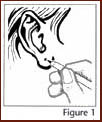
4. Mark the ears appropriately with the non-toxic Marking Pen (Fig.1).
5.Have the customer check and approve the marks BEFORE proceeding with the piercing. The customer should not touch the ear after cleansing.
A NOTE ABOUT CARTILAGE PIERCING-
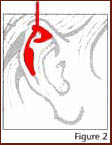
If you are piercing in the cartilage area of the ear (see Fig. 2), special care must be taken during both the piercing and the after-piercing care.
CARTILAGE AREA-
Special care must be taken when piercing through this cartilage (dark aea on right).
Do not pierce through the curled "edge" of the ear. With customers who have very thick or heavily curled cartridge, you must pull the cartilage slightly to "unroll" it when piercing the cartilage around the edge of the ear. This is to ensure that the piercing can be properly positioned. Whenever piercing through any cartilage area of the ear, you must take care to ensure the instrument is held prependicular to the surface of the ear. Alert your client that the healing of the cartilage area will take somewhat longer than the lobe area.
|